

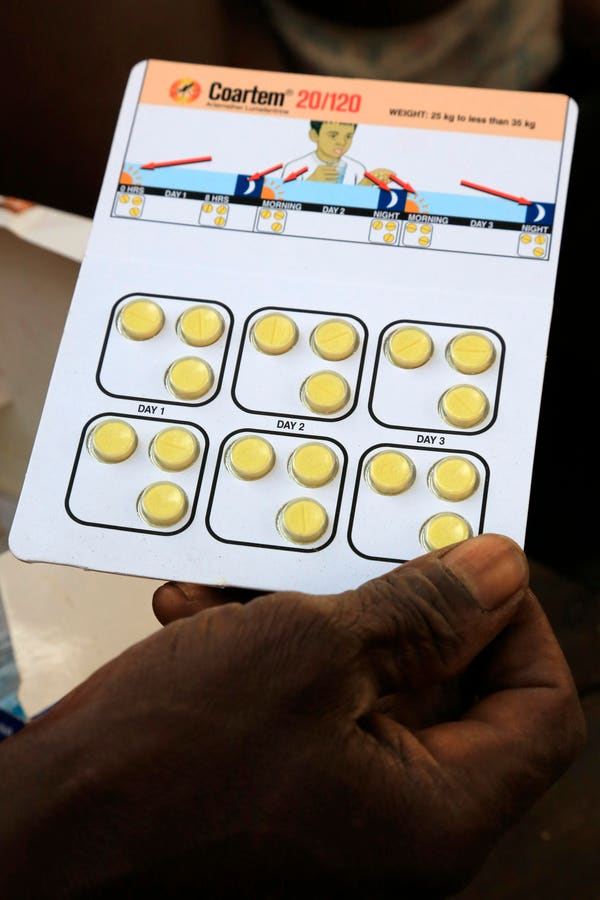
Artemether-lumefantrin for treating malaria. (Photo by: BSIP/Universal Images Group via Getty Images)
Universal Images Group via Getty Images
Maybe you’re accustomed to malaria infections. After the chills, the aches and the lethargy set in, you know the drill: get tested, get treated.
But what if the treatment you’ve relied on before no longer works?
That’s a looming concern for the millions of people who depend on artemisinin, a compound from the sweet wormwood plant that revolutionized malaria treatment starting in the 1970s. Artemisinin-based combination therapies (ACTs) are now the gold standard for responding to malaria. These combine artemisinin derivatives with other medicines, usually in a double combination, though increasingly triple-combination ACTs are being trialled.
The good news is that this problem has been seen before, and countered with some success. The bad news is that that playbook is unlikely to work again.
In Southeast Asia in the 2000s, patients with malaria suddenly started reporting that their artemisinin-based drugs were no longer clearing up their illness. Donors stepped up to fund malaria elimination programs, which hired caseworkers to manage patients with hard-to-treat malaria. And health workers mixed up their combinations of drugs. These efforts essentially quashed the resistance problem. (The exception was Myanmar, whose turbulent political situation thwarted that kind of public health campaign.)
In Africa, “the scale of the problem is very different,” explains Maciej Boni, an epidemiologist at Temple University in Philadelphia. “When artemisinin resistance emerged in Southeast Asia, it was essentially a problem of managing about 100,000 malaria cases…In Africa, the resistant parasites emerged into a population of hundreds of millions of malaria cases per year.” As well, the species of malaria parasite differs between the two regions.
For now, ACTs are effective against malaria. But it’s not clear how long that will remain true, and scientists are racing to get ahead of the problem.
The State Of Surveillance In Africa
The first artemisinin-resistant parasites emerged in East Africa a decade ago. According to Boni, “the biggest challenge is in Uganda, because in Uganda, the parasites are at high levels, the resistant parasites are at high levels, and the malaria burden is high.” Partial artemisinin resistance has also been confirmed in Eritrea, Rwanda and Tanzania, and is further suspected in other countries.
In most African countries, scientists are monitoring drug-resistant genotypes. One critical threshold they’re monitoring is 10%; once a treatment fails more often than this, a replacement is recommended. In West Africa, some researchers are anxiously checking to ensure that levels of resistance there have not reached the East African level.
Overall, however, surveillance is patchy between and within nations. Boni says that, for instance, Tanzania and Burkina Faso have comprehensive molecular surveillance systems in place, allowing them to report significant mutations relatively quickly. But not all countries have such systems.
In Burkina Faso so far, molecular biologists haven’t detected genetic mutations at the level that would make rapid diagnostic tests ineffective. But they can’t relax their vigilance. For one thing, they lack data from almost 2/3 of Burkina Faso’s sentinel sites (health facilities that serve as surveillance samples).
“We need to really continue making the surveillance to be sure at least it’s not happening somewhere,” explains Issiaka Soulama, who heads the Molecular Biology Laboratory at Burkina Faso’s National Center for Research and Training on Malaria (CNRPF) in Ouagadougou. As well, they’re currently working with a two-year data lag. They need data for three consecutive years to establish a baseline.
Anticipatory surveillance is essential because “we should not just wait until our medicines are failing,” argues Michael Audu, an independent malaria policy researcher in Abuja, Nigeria. He calls for systematic tracking not only of how well the drugs are working, but whether the early warning signs of resistance are cropping up. This would mean, in particular, checking for mutations in the key gene Kelch13.
Around the world, researchers are seeking to unspool the mysteries of Kelch13. There are thousands of such proteins in the malaria parasite, points out Tobias Spielmann, who leads the Malaria Cell Biology research group at the Bernhard Nocht Institute for Tropical Medicine in Hamburg, Germany. “It’s like Lego.”
His team’s microscopy experiments have shown that without Kelch13, the malaria parasite doesn’t grow. In other words, “resistance is caused by less Kelch.” But mutations in this gene disrupt the normal workings of the associated proteins. Because of these mutations, the parasite is less able to digest hemoglobin in the early ring stage of the parasite’s lifecycle in human blood.
It might seem that less nutrition for the parasite would be good news for the person suffering from malaria. But actually, Spielmann explains, “anything that reduces eating, reduces resistance.” Artemisinin is activated by hemoglobin digestion, so to get better, patients actually need the parasite to eat.
It’s not yet clear exactly why Kelch13 has its special features. “Artemisinin resistance is a very crazy resistance,” Spielmann sums up. Eventually, findings like his lab’s could help improve drug treatments for malaria.
While not all the biological mechanisms of this resistance are yet known, it’s clear that there is a link to increasing failure of artemisinin-derived drugs. Yet there are big gaps in surveillance of key proteins and enzymes, for instance in parts of Nigeria. “It is troubling for me,” Audu says. “Resistance could absolutely be emerging in Nigerian states right now without one even being aware of it. And that’s actually what the surveillance void means in practical terms.”
A Tough, But Sound, Investment
When it comes to beating back malaria, artemisinin-based therapies aren’t the only game in town. “These are exciting times in the fight against malaria,” Audu notes. A major milestone has been the promising early results of GanLum, the first new type of antimalarial since artemisinin-based combination therapies were rolled out 25 years ago. Thus, GanLum offers an alternative to the existing drugs that the malaria parasite may be starting to tolerate.
But the history of antimalarial medicines suggests that they won’t keep working forever, whether they’re based on artemisinin or other substances. Before ACTs came along, the malaria parasite was building resistance to the older antimalarials; that resistance massively increased the death toll of malaria.
“If you’re releasing drugs into a broken system, you will continue to experience the same thing,” Audu points out. Investment in African health structures is crucial before the next generation of antimalarials are rolled out; otherwise it won’t be very long before we’re having the same conversation about resistance again.
Yet in addition to the geographical and epidemiological challenges of resistance spreading across Africa, the financial challenges have increased in recent years.
“The first general point to remember is that overall funding for malaria is low compared to other things,” says epidemiologist Boni. He estimates that the total global funding for malaria is only about $40 per case. Then, “whether an African country is able to use its resources effectively is what makes the difference in terms of how effectively we’ll be able to respond to the spread of these new parasites.”
For instance, he says, Rwanda has responded relatively swiftly following the discovery of resistant parasite, including drug rotation. In Uganda, which has fewer financial resources, the case numbers are higher and the response has been slower. “What the consequences of this are, we’re not sure yet.”
Tracking resistance is costly. Molecular techniques require skilled staff, supplies and well-maintained laboratories; even basic lab equipment can be expensive to purchase and ship. In Burkina Faso, the Gates Foundation has supported the malaria molecular surveillance. But cost remains a barrier to expanding this work.
Money is also an obstacle to rolling out multiple first-line therapies as a way to stave off resistance. Diversifying the types of artemisinin-based malaria treatments is a good idea, in order to slow the parasite’s buildup of resistance. Yet many African countries depend heavily on a single type, artemether-lumefantrine.
Molecular biologist Soulama says that Burkina Faso has decided, like some other countries on the continent, to move toward multiple first-line therapies. This anticipatory step is necessary because research indicates “that something is happening in terms of reducing the sensitivity of the ACT to a parasite. So we need to prepare.”
Making these medicines closer to home could help bring costs down. There is not yet enough investment in African manufacturing of antimalarials, although this has been growing.
In general, Audu understands the financial constraints to tracking a problem that is looming, rather than the problem that is already here. Referring to trade-offs in Nigerian currency terms, he says, “Every naira directed toward surveillance is not a naira directed toward treatment.”
But he argues that it would be a false economy to skimp on surveillance now, given the massive health and economic consequences that antimalarial drug failure would bring. “Surveillance is not competing with treatment at all; surveillance actually protects treatment…Every antimalaria tablet purchased today depends entirely on the continuous drug effectiveness.” His estimate is “that resistance establishment across West Africa will actually generate a huge economic loss of $78 billion over 15 years.” So a resistance surveillance network across places where this is lacking, such as northwestern Nigeria, would bring a huge return on investment.
The financial crunch has become even tighter since the U.S. Agency for International Development, which funded a number of malaria programs, was dissolved last year. Audu’s estimate is that “for every dollar saved in the short term by cutting malaria bilateral aid, the long-run cost of the artemisinin resistance amplification that that cut creates is actually between $11 and $48.” In other words, it will likely cost at least $11 more to deal with the drug resistance unleashed by the aid cuts, compared to keeping them in place. And that’s the most conservative estimate.
Without action, resistance will mount. “The continent should take the matter of resistance very, very seriously,” Audu warns. “Resistance should be seen as an emergency situation.”
But it’s a slower-moving emergency, which can be hard to build urgency around. Boni likens resistance to a broken dam, rather than a forest fire. “A forest fire runs itself out and it burns up all the trees and it’s gone. A flood doesn’t do that…So you have to do the work of slowing down or reversing the path of drug resistance. If you do nothing, the path of drug resistance just moves forward.”
When it comes to preparation, Soulama says, “I think we don’t have a choice.”
Reporting for this article was supported by a Maria Leptin / EMBO Science Journalism Fellowship.