

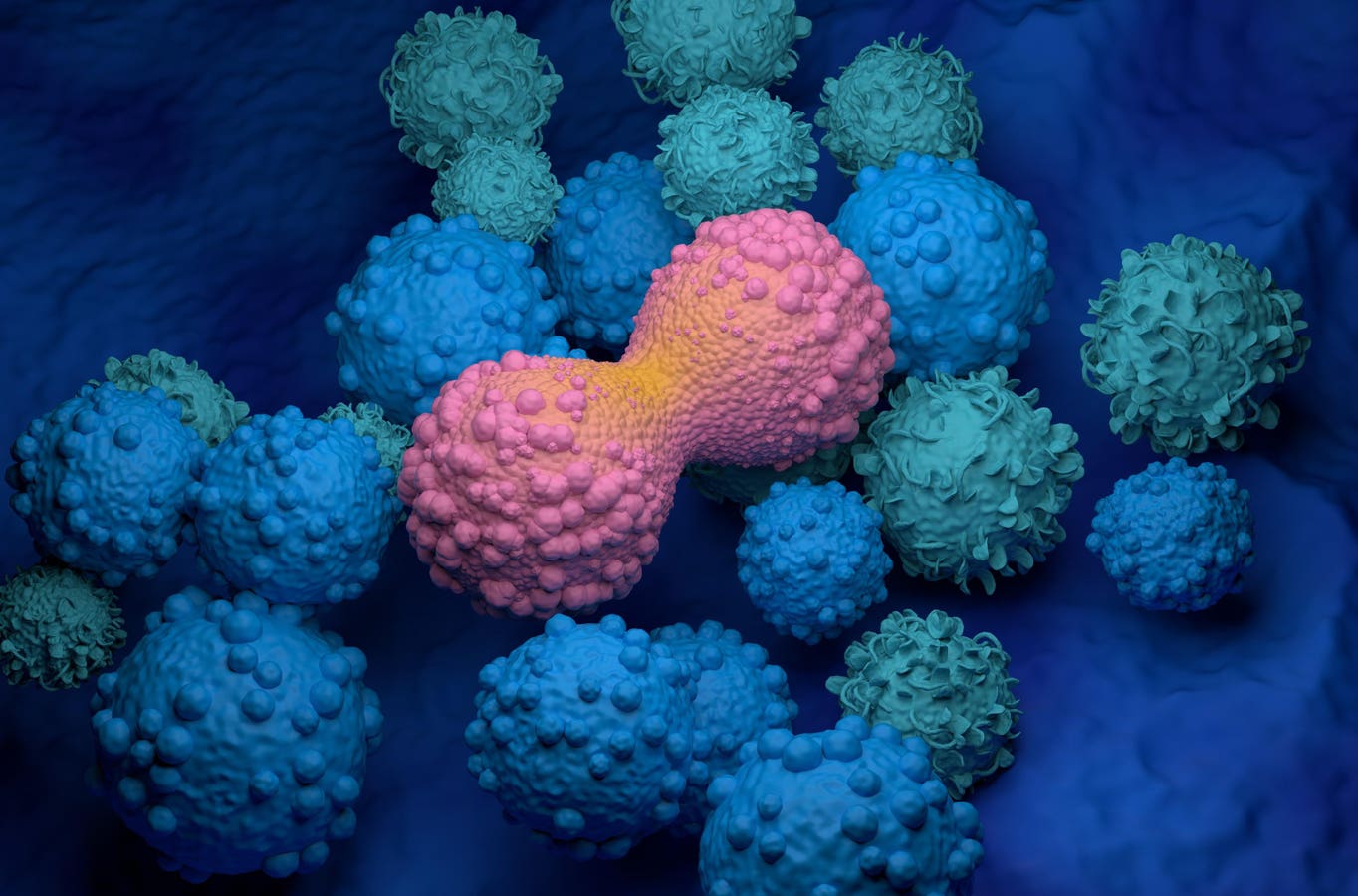
Illustration of cancer cells dividing. Cancer cells are able to divide uncontrollably and often display irregular shapes and sizes when compared to healthy cells
getty
A new class of antibodies recognizes cancer proteins displayed on the surface of tumor cells, opening a new way to target mutations previously considered inaccessible.
Many cancers share a common weakness: a single change in a critical protein can permanently switch on cell growth signals. One example is KRAS, a protein that helps control cell growth and is frequently mutated in pancreatic, colorectal and lung cancers. One of the most common mutations changes a single building block in KRAS, converting the normal protein into a form that continuously drives cell division.
For years, KRAS has been one of cancer’s most difficult targets. The mutated protein sits inside the cell, where conventional antibodies cannot reach it. A new study takes a different approach. Rather than trying to move the antibody inside the cell, newly designed antibodies recognize a small piece of mutant KRAS after the cell naturally displays that piece on its surface.
The strategy allows an antibody to distinguish cancer cells carrying the KRAS mutation from cells carrying normal KRAS, turning a system normally used by the immune system to detect viruses and other threats into a way of targeting cancer.
How Cells Reveal What’s Inside
Cells have a built-in way of showing the immune system what is happening inside them. As proteins are naturally broken down, small pieces are carried to the cell surface by surface display proteins, allowing immune cells to inspect them. This allows the immune system to detect things that would otherwise remain hidden, including pieces of viruses and abnormal proteins.
T cells, a type of immune cell that detects and destroys infected or abnormal cells, normally perform this inspection. They recognize protein fragments displayed by surface display proteins and can destroy cells carrying fragments that signal an infection or other abnormality.
The system is highly selective: different surface display proteins can show different protein fragments, and even a small change in a protein can determine whether a particular fragment can be displayed. That means a cancer-causing mutation can sometimes create a new target that appears on the surface of the cancer cell even though the original protein remains deep inside the cell.
From Recognition to Treatment
The next question was whether these antibodies could be used to make immune cells attack cancer cells. One version of the antibody was incorporated into a drug that connects cancer cells to T cells. The antibody recognizes the mutant KRAS fragment on the cancer cell while the other end connects to a T cell, bringing the two into direct contact and directing the immune cell to attack.
The antibody was also used to engineer T cells so that they could recognize the same mutant KRAS target themselves. Both approaches selectively attacked cells carrying the KRAS mutation. Cells carrying normal KRAS were largely left unharmed.
The results show that a cancer-causing mutation does not need to be exposed on the outside of a protein to become a target. The immune system’s own protein-display system can bring a piece of that hidden mutation to the cell surface, where an antibody can recognize it.
Beyond KRAS
The significance of the approach extends beyond one mutation. Many of the proteins that drive cancer are found inside cells, making them difficult or impossible for conventional antibody drugs to reach directly.
Surface display proteins provide a way around that problem. Cells already display pieces of proteins on their surfaces, potentially creating targets for antibodies against proteins that were once considered inaccessible.
The approach will not work for every mutation. The altered protein must produce a fragment that can be displayed, and that fragment must be presented by a surface display protein type found in the patient. Different mutations and surface display protein types may therefore require different antibodies.
Even so, the study demonstrates a new way to target cancer. Instead of asking how to get an antibody inside a cancer cell, researchers may be able to use the cell’s own surveillance system to reveal what is happening inside. Mutations that were once hidden from antibody drugs could become visible targets for the immune system.