

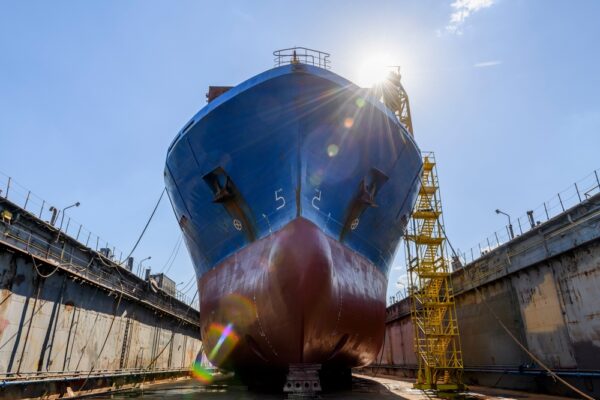
Global shipbuilding demand is likely to remain resilient for the long-term, with increasing geopolitical conflict and uncertainty one of the primary drivers. The 2026 war between Iran, the United States and Israel has caused a spike in demand for alternative suppliers and routes, leading Fitch Rating to revise sectoral outlook to “neutral” from “deteriorating.” According to the non-profit Container Trades Statistics, global container volumes reached 16.2 million 20-foot-equivalent units (mTEUs) in April — the first full month of data since the Strait of Hormuz closures triggered by February’s Persian Gulf crisis — marking a 4 percent year-over-year increase and a 1.6 percent rise over March. Year-to-date volumes are also running 5 percent ahead of 2025 levels.
Shipping sector analysts also predicted that the market had become oversaturated with vessel capacity and fewer orders would be placed to shipbuilders in 2026 and 2027. However, geopolitical disruptions are one major reason why orders have remained strong. Shocks such as Red Sea attacks, the Russia-Ukraine war, the Panama Canal drought, the Baltimore bridge collapse, and now the Iran-Israel-US conflict have demonstrated the importance of excess capacity. Carriers can more easily navigate these conflicts with a large and diverse fleet, resulting in expansive orderbooks that are now treated as insurance rather than oversupply.
These trends are good news to the world’s leading shipbuilding nations, which are highly concentrated in East Asia, particularly China. However, in the current geopolitical climate, there are significant opportunities for Southeast Asian nations to scale up their shipbuilding industries and take advantage of the sustained demand for global trade.
Southeast Asian nations are taking the initiative to capture greater shipbuilding market share through structured international partnerships. At the OECD-Southeast Asia Policy Roundtable on Shipbuilding, Steel, and AI held in Tokyo in February 2026, Indonesia, Vietnam, and Thailand agreed to a regional peer review of their shipbuilding sectors with the OECD, covering priorities such as workforce skills, technical capabilities, supply chain dependencies, energy-efficient ships, and leveling the competitive playing field. The Philippines separately agreed to follow up on implementation pathways for OECD peer review recommendations, while all four countries were invited to join the OECD’s shipbuilding committee meeting in Paris in April.
Continue reading for free at The Diplomat’s new companion publication, The Investor.