

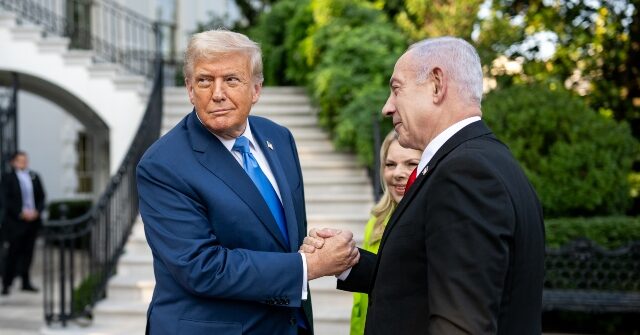
President Donald Trump said Tuesday that he may endorse a candidate in Israel’s upcoming national election, raising the possibility of a high-profile American intervention as Prime Minister Benjamin Netanyahu fights to extend his historic tenure in a closely contested vote that could determine his political future.
“I haven’t thought about it. Maybe I’ll do something. We may endorse somebody in these elections,” Trump told reporters before departing Washington for Alaska.
The remarks came exactly two weeks before Israelis head to the polls on October 27 for the first national election since Hamas’s October 7, 2023, massacre and the subsequent wars against Hamas, Hezbollah, and Iran — conflicts that have reshaped the Middle East while placing Netanyahu’s record and leadership at the center of a fiercely contested campaign.
Trump has not endorsed Netanyahu or any of his challengers. In August, he similarly left open the possibility of intervening in the election while suggesting he would prefer to remain on the sidelines.
“I think it’s most appropriate for me to stay out of Israeli elections, but I may endorse somebody,” Trump said in a Fox News interview at the time.
His latest remarks come against the backdrop of a longstanding political partnership with Netanyahu, whose governments have worked closely with Washington on some of the most consequential developments in the region, including the historic Abraham Accords, which established diplomatic relations between Israel and several Arab nations, and the ongoing military confrontation with Iran.
Netanyahu’s Historic Premiership at Stake
Netanyahu, who turns 77 next week, is Israel’s longest-serving prime minister, having first taken office in 1996 and led the country for nearly two decades across three separate periods in power.
After his initial term from 1996 to 1999, he returned to office in 2009 and remained prime minister until 2021, before regaining power in December 2022.
His supporters point to Israel’s transformation into a global technology and economic powerhouse, its expanding international relationships, and the development of its military capabilities as defining achievements of his leadership — gains sustained despite years of regional instability and repeated security threats.
Among his signature diplomatic accomplishments are the Trump-brokered Abraham Accords of 2020, which normalized relations between Israel and the United Arab Emirates, Bahrain, Morocco, and Sudan, marking a historic expansion of Israel’s ties with the Arab world.
More recently, Netanyahu has emphasized Israel’s military campaigns against Hamas in Gaza, Hezbollah in Lebanon, and Iran itself, including major joint American-Israeli operations against Tehran, as evidence that his leadership has fundamentally shifted the regional balance of power and weakened some of Israel’s most formidable adversaries.
Yet the election also represents a reckoning over the October 7 massacre, when Hamas-led terrorists killed approximately 1,200 people and abducted 251 others in the deadliest attack in Israel’s history.
Netanyahu’s opponents accuse his government of failing to prevent the attack and resisting the establishment of an independent state commission of inquiry into the intelligence and security failures that preceded it.
The prime minister has rejected efforts to place primary responsibility for the disaster on his leadership and defended his government’s conduct of the subsequent war.
The competing assessments have become central to the campaign: Netanyahu’s opponents are seeking accountability for the security failures of October 7, while the prime minister and his allies emphasize the military achievements that followed and his longstanding record on national security.
The election will therefore determine not only whether Netanyahu can extend his record-breaking premiership, but also how Israeli voters assess a political career that has dominated the country’s public life for much of the past three decades.
Eisenkot Leads the Challenge to Netanyahu
Netanyahu’s principal challenger is Gadi Eisenkot, a former Israel Defense Forces chief of staff whose newly formed Yashar party has emerged as the leading opposition force in recent polling.
Eisenkot joined Netanyahu’s emergency war cabinet following the October 7 attack before leaving the government in 2024. His son and two nephews were killed during the war in Gaza, giving his campaign a deeply personal connection to the conflict.
The former general has centered his campaign on national security, political accountability, and demands for an independent investigation into October 7, while presenting himself as an alternative to Netanyahu’s leadership.
He is joined in the broader opposition by former prime ministers Naftali Bennett and Yair Lapid, who are running together under the B’Yachad, or Together, slate; former Defense Minister Avigdor Lieberman, who leads the nationalist Yisrael Beytenu party; and former military deputy chief Yair Golan, who heads the left-wing Democrats.
Despite significant ideological differences, the five opposition leaders met in late September and signed an agreement to coordinate their campaigns, refrain from attacking one another, and work toward forming a government to replace Netanyahu.
Their shared objective has effectively turned the election into a referendum on the prime minister’s continued leadership, even as the opposition remains divided over who should lead a prospective government and which parties could participate in it.
Those differences extend beyond coalition politics. While Golan represents Israel’s political left, Eisenkot, Bennett, and Lieberman hold more hawkish positions on several major security questions, including opposition to establishing a Palestinian state.
Their challenge to Netanyahu is therefore not simply a contest between Israel’s traditional right and left, but a struggle over leadership, accountability, and the country’s political direction following three years of war.
Polls Show Neither Bloc Securing a Majority
Recent polling has reflected the fragmented political landscape, with most major surveys showing neither Netanyahu’s prospective coalition nor the principal opposition parties securing the 61 seats needed to command a majority in Israel’s 120-member Knesset.
An October 7-8 survey conducted for the Times of Israel’s Hebrew sister publication, Zman Yisrael, projected Eisenkot’s Yashar winning 24 seats, followed by Netanyahu’s Likud with 20.
Bennett and Lapid’s joint slate received 13 projected seats, Lieberman’s Yisrael Beytenu ten, and Golan’s Democrats eight.
The poll gave Netanyahu’s prospective governing bloc 51 seats, compared with 55 for the four principal opposition lists, leaving both short of a parliamentary majority. Two predominantly Arab parties were projected to win the remaining 14 seats.
Other recent surveys have produced varying results, including narrow leads for either camp, but the recurring finding across much of the polling has been the absence of a clear 61-seat majority.
Under Israel’s parliamentary system, winning the most seats does not automatically determine who becomes prime minister. The decisive test is whether a party leader can assemble sufficient parliamentary support to form a government.
Netanyahu’s potential partners include the ultra-Orthodox Shas and United Torah Judaism parties, National Security Minister Itamar Ben-Gvir’s Otzma Yehudit, and Finance Minister Bezalel Smotrich’s Religious Zionism alliance.
But disputes over military conscription for ultra-Orthodox men — a major issue in this year’s campaign — have exposed tensions within the right-wing and religious camp. Smaller parties also face the risk of failing to clear the electoral threshold, potentially depriving their respective blocs of crucial seats.
The opposition faces its own coalition obstacles. Several of its leading figures have ruled out governing alongside Arab parties, while Golan has expressed greater openness to their participation.
The distinction between including Arab parties in a coalition and relying on their parliamentary support from outside the government could prove significant if neither major bloc wins a majority.
Israel held five national elections between 2019 and 2022 amid repeated coalition breakdowns, and another inconclusive vote could leave Netanyahu serving as caretaker prime minister while rival parties negotiate a government — or eventually force another election.
For Trump, the October 27 vote comes amid an unresolved confrontation with Iran, continuing regional security challenges, and uncertainty over the direction of U.S.-Israeli relations.
For Netanyahu, the stakes are more personal: whether Israel’s longest-serving leader will secure another term or bring a historic premiership to a close, with his legacy shaped by both the military campaigns that followed October 7 and the security failure that preceded them.
Joshua Klein is a reporter for Breitbart News. Email him at jklein@breitbart.com. Follow him on Twitter @JoshuaKlein.