

Iran is fortifying its nuclear facilities, preparing its population for renewed fighting, and threatening to expand the conflict across the Middle East if the United States launches another round of strikes, as Washington weighs fresh military action against the Islamic Republic.
Tehran has reinforced sensitive nuclear sites, worked to rebuild its depleted military capabilities, and warned regional governments that another confrontation could bring attacks on American warships, Saudi oil facilities, and even ground incursions into neighboring countries, according to a Tuesday report by the Wall Street Journal.
The preparations come as President Donald Trump weighs his next steps against Iran, having ruled out new strikes before the November midterm elections while leaving open the possibility of renewed military action afterward.
Iranian officials have privately warned intermediaries that renewed hostilities could prompt attacks intended to sink American warships and kill their crews, strikes against Saudi oil facilities, and possible ground incursions into neighboring countries, according to people familiar with the messages.
The warnings follow a separate threat Sunday from Maj. Gen. Mohsen Rezaei, secretary of Iran’s powerful Supreme National Security Council, who said Tehran could target American-linked undersea communications cables, data centers, and artificial intelligence facilities across the region if fighting resumes.
Rezaei valued the American-linked technology infrastructure at more than $2 trillion, warning that assets previously excluded from Iranian targeting calculations could become vulnerable in another war.
“The pulse of the American economy in this region runs through our part of the world,” he told Iranian state broadcaster Press TV.
Meanwhile, satellite imagery analyzed by the Institute for Science and International Security shows Iran has erected earthen barriers and other makeshift defenses around its Pickaxe Mountain and Natanz nuclear sites, apparently intended to complicate potential attacks or ground operations.
The fortifications follow months of activity at Pickaxe Mountain, a heavily protected underground complex that has drawn particular scrutiny over concerns Tehran could use it to restore uranium-enrichment capabilities.
International Atomic Energy Agency Director General Rafael Grossi acknowledged signs of activity around Pickaxe Mountain in September but cautioned that inspectors lacked concrete information about what was taking place inside the underground complex.
“There are some indications that there is movement around this construction site,” Grossi told Bloomberg Television at the time. “We don’t have any concrete information as to activities that may be taking place there.”
Separate satellite imagery released last week also showed renewed construction and other activity at Minzadayi, a suspected nuclear-weapons development site northeast of Tehran that Israel struck in March.
The Institute for Science and International Security said the activity could indicate an attempt to restore capabilities lost in the attack, although the imagery alone does not establish that nuclear-weapons development has resumed.
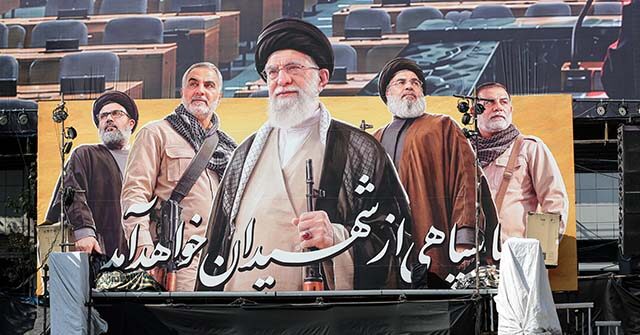
Beyond its nuclear facilities, Iran is rebuilding missile and drone capabilities while mobilizing civilians for another confrontation. Authorities have organized rallies, promoted training in shoulder-fired anti-aircraft weapons, and dispatched members of the Basij paramilitary organization to kindergartens to deliver wartime messages.
Brig. Gen. Gholamreza Jalali, who oversees Iran’s civil-defense preparations, said the country’s airports, seaports, and power plants “have prepared for wartime conditions.”
The United States, meanwhile, is reinforcing its military presence in the region, with a third aircraft carrier strike group and another Marine expeditionary unit heading toward the Middle East.
The military buildup comes amid reported discussions between Trump and Israeli Prime Minister Benjamin Netanyahu about another major operation against Iran.
Axios reported Tuesday that the two leaders discussed the possibility of renewed strikes during several conversations over the previous two weeks, with Netanyahu raising concerns about Israeli intelligence suggesting Tehran was rebuilding parts of its nuclear program, including the possibility of using Pickaxe Mountain as a uranium-enrichment facility.
“Bibi seems to want to go in again,” one American official told the outlet, saying Trump had effectively told Netanyahu to “go ahead and get ready” without committing to another operation.
A White House official disputed the account, calling it “false” that Trump and Netanyahu had discussed resuming the war and reiterating the president’s position that the United States would not attack Iran before the midterms.
Within the administration, War Secretary Pete Hegseth and U.S. Central Command leaders have reportedly been among the strongest advocates of renewed strikes.
Other administration advisers, however, favor continuing the economic pressure campaign, arguing that the American blockade and financial restrictions are increasingly weakening Tehran without requiring another major military operation.
“They claim this economic choking is working better and better. Let’s keep it up,” an American official said, describing that position.
The competing approaches come amid an intensifying American effort to isolate Iran economically, with Treasury Secretary Scott Bessent declaring Sunday that Washington’s campaign had moved beyond maximum pressure to “absolute isolation.”
The administration has targeted Iranian oil exports, shadow-fleet shipping, sanctions-evasion networks, and access to overseas assets while maintaining a naval blockade that has sharply restricted Tehran’s ability to generate revenue.
The possibility of renewed fighting has also figured in military discussions, with Israeli military chief Lt. Gen. Eyal Zamir and Joint Chiefs Chairman Gen. Dan Caine reportedly discussing a potential return to full-scale hostilities within three weeks.
Zamir reportedly warned that fighting on that timeline could force Israel to postpone its October 27 election because of an anticipated Iranian missile response.
At the same time, indirect negotiations remain unresolved, with Qatari mediators awaiting Tehran’s response to the latest American counterproposal aimed at ending the conflict and securing nuclear concessions.
“The negotiations are not really dead, but they’re not really alive,” a U.S. official said. “We’re just here, piling on the pressure and there’s a belief that smarter heads will prevail over there.”
Iran has continued resisting Washington’s demands, with Rezaei declaring Sunday that the American response to Tehran’s seven conditions for reopening the Strait of Hormuz was inadequate.
“We are not in the process of responding to the Americans. They have responded to us, and we consider their response inadequate,” he said.
Iranian nuclear chief Mohammad Eslami also rejected the prospect of abandoning uranium enrichment last week, responding “Under no circumstances” when asked whether Tehran would relinquish that capability.
Trump, meanwhile, indicated Tuesday that Washington was approaching another decision on Iran, while maintaining that American forces controlled the Strait of Hormuz despite continuing threats to commercial shipping.
“Iran is a failed country. They have no economy,” the president said. “We’ll make a decision on Iran very soon. We control the Hormuz Strait, and a lot of oil is coming out of the Hormuz Strait.”
Joshua Klein is a reporter for Breitbart News. Email him at jklein@breitbart.com. Follow him on Twitter @JoshuaKlein.